Monday, December 14, 2015

It Ain't Easy Being an Elf

The Santaland Diaries --- MTC Mainstage -- Thru Dec. 20

Matt Densky as "Crumpet"

So you come to New York with stars in your eyes and hopes of landing a role in one of your beloved soap operas. Oh, silly you! Out of work, you read an ad that announces that Macy’s – yes, the biggest store in the world – is hiring -- hiring elves for its Santaland. You say, “What hell!” and go for an interview and, wonder of wonders, you land the job. Be careful what you wish for.

Such is the premise of The Santaland Diaries, MTC’s Christmas offering running through December 20 at its new home in Norwalk. Directed by Kevin Connors, this slight, sarcastic take on the holidays appeals to the Scrooge in all of us. If you gag at the thought of eggnog, disdain electronic reindeer and whirling Santas on your front lawn, and wish that every copy of “Here Comes Santa Claus,” sung by Gene Autry, would magically disappear, then this is the show for you.

Santaland, based on a David Sedaris essay and adapted by Joe Mantello, is a one-man, single-set show that is basically an extended monologue, and as such, rests on the skills of the actor portraying Crumpet, the elf-name given to the hapless out-of-work wannabe actor. As Crumpet, Matt Densky fills the turned-up elf shoes admirably, although one might ask him to tone down the fey aspects of elfishness a bit –there’s just one too many strokes of the eyebrow.

However, the story Crumpet tells is entertaining, for he is exposed to all the mania and hype that the holidays can offer as he shuttles visitors into the magical world of Santaland, visitors who include youngsters terrified of Santa, visitors who wish to capture the moment on film as if it is a Cecil B. DeMille production, visitors (from New Jersey) who tell Santa they “Want a broad with big tits” for Christmas (Haw! Haw! Haw!), visitors who pee on Santa’s lap or toss soiled diapers into the decorations, and foreign visitors who are essentially clueless.

Then there are the Santas, a mixed lot of lost souls who handle the visitors with various degrees of kind attention or disdain.

Then there are Crumpet’s fellow elves, a varied lot of folks who would rather be anywhere else than in Macy’s dressed as elves (“I’m really an actress!”) and who, in devious and not so devious ways, deal with the long lines of Christmas shoppers who wish to whisper their consumer wishes into Santa’s ear.

Densky romps about the candy-cane set, designed by Carl Tallent, as he tells his tale of holiday woe, striking poses and evoking the various matrons, children and fathers who have come to worship at Santa’s boots. He is arch, snarky and, if nothing else, the essence of the put-upon, all-suffering Santa’s helper.

The only false note in the evening is its conclusion, for Sedaris – and Mantello – can’t help but succumb to the candy-cane-Miracle-on-34th-Street-Christmas-in-Connecticut-Grinch-Rudolph-Scrooge-God-Bless-Us-All syndrome, for on the “last shopping day” Crumpet gets to work with a Santa who goes off script and asks questions of the visitors that evoke the “true spirit of Christmas.” It’s a maudlin touch that, I guess, is meant to bring a tear to the eye, but for those of us who would have written a different editorial to little Virginia when she asked if there really was a Santa Claus, it only confirms that you can’t keep cant out of Christmas.

God rest ye merry gentlemen, for the season will pass and all that will be left will be the credit card bills, a lot of torn wrapping paper and dead pine trees lining the curb. Oh come all ye faithful to the malls!


The Santaland Diaries runs through Dec. 20. For further information or ticket reservations call the box office at: 203.454.3883 or visit: www.musictheatreofct.com.

Sunday, December 6, 2015

A Farcical "Twelfth Night"

"Twelfth Night" -- Connecticut Repertory Theatre -- Thru Dec. 19

Richard Ruiz (Sir Toby), Mark Blashford (Andrew Aguecheek),
Andrew Ramcharan Guilarte (Malvolio), Curtis Longfellow (Fabian)
 

On the twelfth night of Christmas, the Lord of Misrule reigns supreme. Shakespeare apparently penned his “Twelfth Night” with that idea in mind and, as boarded by the Connecticut Repertory Theatre, this comedy of misrule and mistaken identities, under the direction of Victor Maog, gets a boisterous treatment.

The emphasis here is on broad comedy as Viola (Juliana  Bearse) and Sebastian (Jeff DeSisto), twins, are shipwrecked off the shore of Ilyria. Viola, for reasons never fully explained but, what the hell, decides to disguise herself as a man and serve Count Orsino (Darren Lee Brown), whom she immediately falls in love with.

Ah, but there are complications (of course), for Orsino is in love with Olivia (Madison Coppola), and sends Viola, now disguised as a man, to woo the fair maid in his place. Olivia promptly falls in love with the emissary. Oh, what is to be done?

Olivia, now smitten, must still deal with the misrule in her own household, most of it generated by Sir Toby Belch (Richard Ruiz), who is milking Sir Andrew Aguecheek (Mark Blashford) for all he is worth with the help of Fabian (Curtis Longfellow) while bedeviling Malvolio (Andrew Ramcharan Guilarte), Olivia’s steward.

The love triangle proceeds apace as Sir Toby, with the assistance of Maria (Arlene Bozich), Olivia’s gentlewoman, dreams up a plot to lure the pompous Malvolio to believe that his mistress is in love with him and wishes him to dress in yellow stocking, be cross-gartered, and smile a lot.

It all comes to a “Who are you, sir? Nay, who are you?” conclusion, with everyone satisfied, matched and married save for poor Malvolio, probably the most abused character in the Shakespearean canon.

Maog has taken the spirit of Twelfth Night to heart, and has apparently urged his actors to lay it on thick whenever possible. Purists may squirm a bit, but there’s no denying that his vision has been faithfully brought to life by a primarily young cast (lots of students up there on the stage) that eagerly cavorts and emotes.

Bearse, who had a bit of trouble with her moustache during the performance I saw, gives us an endearing Viola, although it’s a strain to believe that she could be mistaken for her brother (always a challenge when casting this play). However, she handles being “male” with aplomb, not an easy task.

However, there are some show-stealers up there, chief among them Blashford, as Aguecheek, Coppola as Olivia, and Guilarte as the much put upon Malvolio. Blashford is awkwardness personified, with one stocking up and the other down, all flailing legs and arms. It’s an engaging performance. And Coppola is mesmerizing as the love-struck Olivia, easily portraying her character’s rising passion and bringing it to a state of controlled dementia. Then there’s Guilarte as Malvolio. If you looked up the word “pomposity” in the dictionary, you’d probably find his picture. His extended cross-gartered scene is priceless.

Scenes are delineated by a set of doors (created by scenic designer Brett Calvo) that open and close and frame what looks like an upside-down birch tree (its symbolism escaped me). The flash and fury of the storm that opens the show is supplied by sound designer Abigail Golec and lighting designer Justin Poruban.

There’s an attempt to give a holiday overlay to the proceedings via two somewhat drab Christmas trees and some carols disguised as Medieval music. It all seems somewhat superfluous and forced, but, ‘tis the season.

Is this the definitive production of “Twelfth Night”? No, but it has many charms and, given Moag’s directorial intent, is of a piece. You may find Viola’s pawing of Orsino a bit much, and have to work hard at suspending your disbelief at certain moments, but there’s a lot of energy up there on the stage and some fine performances.


“Twelfth Night” runs through December 19. For tickets or more information call 860-486-2113 or go to www.crt.uconn.edu.

Saturday, December 5, 2015

The Passage to Manhood

Passing Strange -- Playhouse on Park -- Thru Dec. 20

Darryl Jovan Williams (Narrator) and Eric R Williams (Youth).
All photos by Photo Rich Wagner
Over 90 years ago, Warner Brothers released “The Jazz Singer,” starring Al Jolson. It was the story of young Jakie Rabinowitz, who runs away from his home and his Jewish heritage to become a jazz singer. Ultimately, his father’s illness brings him back home, and he sings Kol Nidre as the spirit of his father hovers nearby.

Fast forward nine decades to Playhouse on Park in West Hartford and we have “Passing Strange,” directed by Sean Harris and exuberantly choreographed by Darlene Zoller, in which a young black man, simply called Youth (Eric R. Williams), a neophyte songwriter and musician, rejects his heritage and leaves his home and his mother in search of his Muse, traveling first to Amsterdam and then to Berlin, gaining experience and lessons about the heart, only to be called back to Los Angeles, his home, at the news of the death of his mother.

Famecia Ward and Eric R. Williams
If it worked once, why not again? This time around, the music is a blend of hip-hop and rock, and the young man’s experiences are a bit more physical and visceral, but the plot line, delivered by the Narrator (Darryl Jovan Williams), remains essentially the same. With book and lyrics by Stew and music by Stew and Heidi Rodewald, this artistic coming of age odyssey (in German it’s called a Kunstlerroman) is nothing if not energetic. The cast of seven, including Famecia Ward, Karissa Harris, Skyler Volpe, J’royce and Garrett Turner, backed by a hard-driving quartet of musicians, is in almost constant motion throughout the entire two-plus hours of the show, generating enough energy to power most of the businesses on Park Road. The actors roam and romp freely about the thrust-stage area and often invade the house with a lot of in-your-face antics that both titillate and ignite the audience.

But…does this work? The answer is yes and no, for there are times when things get just a bit muddy and you are not sure what is happening or, more importantly, what is being sung. Though the musical is not entirely sung-through, there are many moments that can only be explicated by hearing the lyrics, sometimes a difficult task.

Garrett Turner, J'Royce, and Karissa Harris
However, there are other moments, and they are many, when things are crystal clear, as when our “hero” equates gospel with rock in the "Blues Revelation/Freight Train" number, or in the over-the top “It’s All Right” number, which is reprised after the curtain. There’s a humorous satire on French New Wave films and a lengthy Berlin sequence that has the Youth participating in a May Day riot (in which scenic designer Emily Nichols’ set is de-constructed to successfully evoke chaos), which leads to "The System Does All Kinds of Damage,” with Turner intimidating the audience with his character’s existential/nihilistic mantra. When it’s suggested by the inhabitants of a Berlin hostel that the Youth doesn’t belong because he hasn’t suffered enough, Williams bewails his former life as an oppressed black youth (all fabricated), which garners him accolades and acceptance and leads to the witty “The Black One” number.

Oddly enough, this is also a memory play – or musical – for if you note the footwear worn by both the Narrator and the Youth, you realize that the two characters are one in the same, separated by decades and experience. This, which is subtly hinted at through costume and dialogue in the early parts of the musical, makes the final funeral scene, when Narrator and Youth confront each other, especially poignant. A question, however, might arise – is the link just a tad too subtle? Would “Passing Strange” be more comprehensible, and more moving, if the connection between the two characters was more overt from the start? Well, maybe it is – all you have to do is look at the photograph on the cover of the show’s program to get the message (would that the photo have included the red, low-cut sneakers both characters wear).

Eric R. Williams, Karissa Harris and Garnett Turner
The musical’s title is an allusion to a line from “Othello (“She swore, in faith 'twas strange, 'twas passing strange”), but it can also refer to light-skinned blacks “passing” for whites (something Youth’s grandmother did), as well as the Middle Passage, part of the journey into slavery for millions of Africans (Youth, having become “The Black One,” performs a number in chains that alludes to this). Finally, the title can also refer to the always strange passage of time, if reflected upon in retrospect, that allows Youth to mature into the man he will become (hence the “Passing Phase” number sung by the Narrator and Youth near the end of the show). Whatever the interpretation, and even though the musical had a Broadway run that was well received (and was subsequently filmed by Spike Lee), the book could still use some trimming and some of the musical numbers could be shortened without ill effect.

This is a multi-faceted work that is probably best appreciated with a second viewing – if you know “what’s going on” you are more likely to fill in some of the blanks yourself, musical numbers that seem to stand alone upon first viewing will generate connections, and allusions will be more easily grasped. In any event, kudos to Playhouse on Park for opting to stage this somewhat challenging work, and to a cast that, if nothing else, gives its all to help make for an evening of theater that, while demanding, will resonate on many levels during the drive home.


“Passing Strange” runs through Dec. 20. For tickets or more information call 860-523-5900, X10, or go to www.playhouseonpark.org

Friday, December 4, 2015

Less Than "Peerless"

"Peerless" -- Yale Repertory Theatre -- Thru Dec. 19

Teresa Avia Lim and Tiffany Villarin. All photos by Joan Marcus
Any parent of a high school junior living in suburbia knows the pressure his or her student is under, pressure primarily created by the drive to get into the best school possible. The syndrome seems universal, but some students, and their parents, take it into over-drive, making admission into “The College” something of a quest for the Holy Grail. Success means a heavenly future is all but insured; failure means eternal damnation. Such is the background for “Peerless,” a play by Jiehae Park receiving its world premiere at Yale Repertory Theatre under the direction of Margot Bordelon. The title is unfortunate, for though the play offers some enjoyable moments, it’s essentially a one-trick pony with the Bard riding along as sidekick.

Against a somewhat austere set created by Christopher Thompson that serves as a high school hallway, a classroom, a bedroom and living room (and finally the hallowed halls of “The College”), twin sisters, M (Tiffany Villarin) and L (Teresa Avia Lim) plot and connive to gain admittance to their dream college. The only problem is, there are few slots, and one has been taken by one of their fellow students, D (JD Taylor), a nerdy sort who, the sisters believe, truly doesn’t deserve to be crowned king of the college contest.

Tiffany Villarin and Caroline Neff
M is somewhat ambivalent about whether she should usurp D’s place, but her sister urges her on, and here we have strains of the Bard a la “Macbeth.” Standing in for the three “black and midnight hags” is Dirty Girl (Caroline Neff), who smokes, swears and dresses as if she is planning to be nominated for Biker Queen of the Year. Yet she has prescient powers and suggests to M that M’s dreams will be fulfilled if only she take hold and act. Then there is BF (Christopher Livingston), whose function is unclear, but he’s apparently there to stand in for the student body.

There’s a lot of potential in “Peerless.” The opening scene, an extended running argument between the two sisters, with the actors delivering their lines in machine-gun fashion, often biting into each other’s lines, captures the essence of college-crazed teens. There’s the comparison of SAT scores, the lengthy list of AP courses taken, the boasting of GPAs, and the impressive recital of extra-curricular activities, all delivered in a semi-frantic manner that exquisitely captures the manic nature of this pursuit of the treasured acceptance letter, but then the Scottish play starts to sneak in, and what might have been a considered analysis of the insanity currently rampant in thousands of households, with 17-year-olds becoming sleep deprived as they reach for the golden ring, becomes more and more unbelievable, and irrelevant.

JD Taylor, Teresa Avia Lim and Tiffany Villarin 
Suffice it to say, there will eventually be a “damned spot” that cannot be expunged and, in true Shakespearean fashion, bodies will be strewn about before the final curtain – all to what purpose remains to be seen. That not much is actually going on up on the stage – there’s an extended high school prom scene that, in and of itself, is quite enjoyable, but it seems to belong to another play, or perhaps to be an outtake from “Pretty in Pink – is masked by the overly intrusive projections designed by Shawn Boyle and the frenetic lighting created by Oliver Wason. The visual pyrotechnics urge you to believe that there is import to all of this. There isn’t.

Christopher Livingston and Tiffany Villarin
Forgetting about the Macbeth-Lady Macbeth burden the two sisters have to bear, when Lim and Villarin go at it, as they do quite often, the stage lights up and you get the sense of where this play might have gone. When they are just being teenagers, they are terrific, but when they have to plot dark and dirty deeds, well, we’re into metaphor-land here, and it trivializes what has become, as many psychologists and sociologist have noted, a serious situation. One need only look at the cover article of The Atlantic’s December issue – “The Silicon Valley Suicides” – to understand the nature of the problem and the devastating effect it is having on some of the best and brightest teenagers.

That the drive to succeed at all costs, a drive that is ruining young lives, cries out to be dramatized goes without saying. Some have gone so far as to describe this hyper-pressure to gain acceptance at elite colleges and universities as a sickness in the nation’s soul. Unfortunately, “Peerless” settles for pseudo-allusions and a lot of flash and bang. One can only wonder what Arthur Miller, if he was alive today, might have done with the overwhelming burden being placed on our teenagers to succeed. What words would he have written for the Requiem, and whose passing would be mourned?


“Peerless” runs through December 19. For tickets or more information call 203-432-1234 or go to www.yalerep.org

Thursday, December 3, 2015

Taking Good Measure of Shakespeare

"Measure for Measure" -- Long Wharf Theatre -- Thru Dec. 20

Andy Grotelueschen and Emily Young. All photos
by T. Charles Erickson

Some say it’s a comedy, others a problem play, but whatever label you give it, “Measure for Measure” is pure Shakespeare, and in the Fiasco Theater’s production, currently showing at Long Wharf Theatre, it is as bright and engaging as it probably was when first boarded at the turn of the seventeenth century.

The emphasis here is on the actors, for the set, designed by Derek McLane, consists of just six doors, mounted on casters, doors that are wheeled about by the six actors playing multiple roles to establish the various scenes. Costumes, by Whitney Locher, are basic, and the lighting by Christopher Akerland is expressive but not overly dramatic.

The minimal set
Thus, if falls upon this extremely talented ensemble to create the world of Vienna circa 1600, when the Duke (Andy Grotelueschen) decides to take a busman’s holiday, leaving the running of the duchy to Angelo (Paul L. Coffey), a man of great probity who believes in strict adherence to the rules of law, one of which condemns fornication. Alas, Claudio (Noah Brody) has gotten his intended pregnant, and for this Angelo condemns him to death, much to the concern of Escalus (Jessie Austrian), a Justice. In an attempt to save him, Lucio (Ben Steinfeld), a libertine and frequenter of the local bawdy houses, seeks out Claudio’s sister, Isabella (Emily Young), who is about to take her vows as a nun, and urges her to beg Angelo to pardon her brother. Of course, complications ensue, all resolved by marriages bitter, sweet and…well…tentative.

There’s been a lot of cutting and splicing here, as often occurs when one of the Bard’s plays is staged today, but no harm is done – the play’s essential message stands intact: those in power who would judge others must themselves be judged by their actions.

The cast of "Measure for Measure"
As is often the case when viewing one of Shakespeare’s plays, it takes a few minutes to adjust to the rhythm and syntax of the prose, but once the ear and the mind shed their twenty-first century focus and expectations, you could easily be standing in an inn-yard watching the play as pickpockets and pie-men wander about.

This is a vigorous production, powered by some very fine performances. Chief among them is Young’s portrayal of Isabella (she also plays Mistress Overdone, the owner of one of the bawdy houses). Her plea for leniency before Angelo and her subsequent condemnation of him in the final scenes are powerful pieces of acting. It is, however, Steinfeld who almost steals the show, for as Lucio he wittily brings to life a man whose morals are made to fit the occasion, whatever the occasion might be.

Then there is Grotelueschen as the Duke, who disguises himself as a friar to observe the goings-on in the land he rules, and thus provides many opportunities for dramatic irony, especially in his scenes with Lucio.

Yes, this is condensed Shakespeare, but the Fiasco Theater ensemble captures the essence of the play, and the staging by Brody and Steinfeld creates a non-stop energy and interaction that holds the audience’s attention throughout.

There is, however, a flip-side to this Shakespeare-lite production. It was, at least for one observer, sometimes difficult to enter into the world of the play. Given the staging, one is never too far away from realizing that these are actors performing roles. That may have been the point. If so, it occasions a slightly schizophrenic experience. Are we watching Isabella or are we watching Young portray Isabella? The experience is akin to having a view of the inside of the magician’s hat to see where the rabbit is hidden.

It’s obvious that there is an overriding concept to this production and as such, it is successful. For some, the concept may distract from the story Shakespeare set out to tell; for others, it creates an Elizabethan romp. Either way, Fiasco Theater’s interpretation is entertaining and, at moments, mesmerizing, no more so than when the Duke sheds his religious garb and reveals himself – it’s a delightful, visually comic moment (thanks, especially, to Steinfeld’s Lucio, who, caught in lies and calumnies, simply doesn’t know which way to turn).

At just over two hours, this “Measure for Measure” is ideal for those who consider themselves Shakespeare-averse. Yes, purists might say this is bare-bones Bard, but in sanctifying the plays we often lose sight of the fact that they were meant to be staged before a somewhat rowdy audience whose attention span was challenged by all that was going on about them. Say what you will about this interpretation, it holds your attention.


“Measure for Measure” runs through December 20. For tickets or more information call 203-787-4282 or go to www.longwharf.org.

Sunday, November 8, 2015

An Almost Wonderful Life

A Wonderful Life -- Goodspeed Opera House -- Thru Dec. 6

The finale. All photos by Diane Sobolewski
Have you ever seen Frank Capra’s film It’s a Wonderful Life? I guess that’s like asking, are you breathing? For most, if not all of us, the film is implanted in our minds, so what would you do if someone pitched the idea of turning the iconic film into a musical? Well, if you’re Sheldon Harnick (book and lyrics) and Joe Raposo (music), you say, “Great idea. Let’s do it.” And the result is what’s currently playing at Goodspeed Musicals. The run has been extended through December 6, so the ticket-buying public is happy, and there’s really no reason not to be happy, save that A Wonderful Life, as directed by Michael Perlman, simply is not up to Goodspeed’s standards. It induces smiles and generates a warm if somewhat dim glow, but as musicals go, it’s somewhat lackluster.

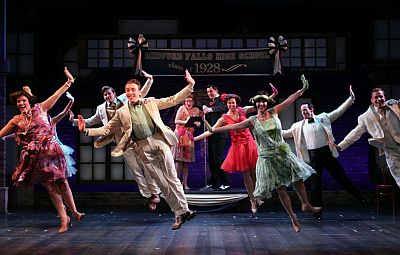
Okay, we all know about good-hearted George Bailey (Duke Lafoon), the man who sets aside his dreams to save the Building and Loan Association in Bedford Falls, and Mary (Kirsten Hatch), the girl he falls in love with, and Clarence (Frank Vlastnik), the angel second-class who is assigned to show George just how important his life has been and, in the process, hopefully win his wings. And we all know…well, we all know -- so much so that when Harnick deviates from the original story for dramatic or staging reasons there’s a little bell that goes off in our minds and we say, “Wait a minute, didn’t George…?”

But let’s start with the set, designed by Brian Prather. Yes, Goodspeed has limited fly and wing space, but that has never stopped the venerable venue from coming up with some interesting and creative solutions to set design. This time around, we have a single set (with some stage pieces rolled in and out as necessary) that reminded at least one audience member of a depressed New England mill town. It’s dark, dingy, drab and sad, as is the poor Christmas tree that Mary decorates near the end of the second act. Misshapen and under-decorated, it looks like something Scrooge might have settled for before his epiphany. Bah! Humbug!

Frank Vlastnik as Clarence
Then there’s Raposo’s music, which seems to have been composed when he was in his “blue” period. Serviceable at best, the songs don’t linger in your mind for a moment longer than it takes for their last notes to fade away. You certainly don’t leave the theater humming a happy tune. As for the choreography, which has always been a hallmark of a Goodspeed production, Parker Esse seems to have taken his cue from Prather, for the less than dynamic dance numbers are in sync with the drab set. Yes, there’s coordinated movement, but only the Charleston scene (“In a State”) generates any energy or excitement.

The "In a State" number
Is this sour grapes because the musical is not the movie? No, not really. I was more than willing to accept and embrace the production on its own terms. It’s just that this time around Goodspeed seems to have missed the mark, though the somewhat flat effort cannot be laid at the feet of the superb cast. Lafoon, to his credit, doesn’t try to fend himself off as Jimmy Stewart – he is his own George Bailey, and is quite believable as the idealistic young man who reluctantly falls in love – it’s a touching scene, helped by the pert Scott, who easily gives us the essence of the wholesome young woman who deserves George’s love.

Ed Dixon and Duke Lafoon
What about the man everyone loves to hate? That’s Henry Potter, and Ed Dixon is the epitome of the grasping, conniving businessman, weaving a Mephistophlean web in “First Class All the Way.” And our angel second-class? Vlastnik is as meek, mild and earnest as you might wish him to be. And the somewhat forgetful Uncle Billy? Michael Medeiros is dead-on as the somewhat whiskey-challenged relative who somehow manages to lose the bank deposit (we all know who’s behind that – Potter! – Hiss! Hiss!) that puts dear George in jeopardy and leads to the heartfelt conclusion.

Back to the set. When George decides it would have been better if he had never been born and Clarence sets about to show him the world as it might have been without his presence, the soul-deadening nature of “Potterville” has little impact, primarily because Bedford Falls was pretty drab and depressing to begin with. Thus, the dark night of the soul scenes just don’t seem very dark – heck, we’ve been there almost from the start.

There are flickers of what might have been (i.e., Wonderful Life fully re-imagined), especially in the “Wings” scene that opens the second act. It’s a Busby Berkley-style number that captures Clarence’s desire to soar amongst the angels. It’s a bright moment in an otherwise dark production that quite often trades on the audience’s memory of the emotions generated by the Capra film to legitimize itself.   

I come back, finally, to the Christmas tree. In the final crowd-gathered scene when goodness is celebrated in an ensemble number (“Christmas Gifts”), one might expect the sad little tree to get into the spirit of the moment and turn itself into something Rockefeller Center might be proud of. Alas, the fake fir just doesn’t seem to understand the theatricality of the moment. There it stands in all of its slumped shabbiness. A missed moment, as is much of A Wonderful Life.


A Wonderful Life runs through December 6. For tickets or more information call 860.873.8668 or visit: www.goodspeed.org.   

Saturday, November 7, 2015

Liberace Lives

Liberace! -- Ivoryton Playhouse -- Thru Nov. 14

Daryl Wagner

For a certain generation – or several generations, for that matter – say the word “candelabra” and an image immediately arises: that of a handsome, dark-haired man with an infectious grin sitting at a piano. The man was Liberace. The entertainer who became synonymous with Las Vegas long before Wayne Newton appeared on the scene died in 1987, but he is back on stage out at Ivoryton Playhouse in an uneven yet eventually enthralling one-man show that features some marvelous music that frames the details of the man’s rise to fame and fortune, his fall and resurrection.

Liberace!, written by Brent Hazelton and directed by Jacqueline Hubbard, ably captures the over-the-top glitz and kitsch that was Liberace’s trademark. Daryl Wagner, who played Liberace for 20 years in the Vegas Legends in Concert, brings the master showman to vivid life, walking the audience through the man’s life and times while performing quite admirably on the piano.

Born Wladziu Valentino Liberace in 1919, the young man was destined by his father to become a world-renowned pianist playing only the classical repertoire, but as young Walter, as he was called by his family (his friends called him Lee), reached his majority the Great Depression had the country in its grips, so to make a buck Liberace began playing gigs wherever he could, including strip joints. His father, something of a martinet, was not pleased. Liberace tried to live up to his father’s expectations, eventually earning the right to play with the Chicago Symphony Orchestra. However, it was in La Crosse, Wisconsin, in 1939, that Liberace found his muse and his true calling. After performing a series of classical pieces, he asked, on a whim, for requests from the audience, expecting them to stay in the classical mode. However, a man from the audience requested that he play “Three Little Fishies.” Liberace did, doing riffs on the song in the style of several classical composers. The audience loved it, and so did Liberace. That night, a star was born, a star who would eventually become the highest-paid performer in the world.

Yet there was a ghost in Liberace’s closet that would haunt him for his entire life and even beyond the grave, and that was the issue of his sexuality. The 1950s was, among other things, a somewhat sexually repressive era and the stigma of homosexuality could be a certain death-blow to any personality’s career. Liberace filed two different lawsuits against publications that had hinted (not so subtly) that the entertainer was gay. The Confidential ran a front cover picture of him with the headline: “Why Liberace’s Theme Song Should Be: ‘Mad About the Boy.” The same issue also ran a cover story with the headline: “Now – Surgery Cures Frigid Wives.”

Though he won the suits, his star seemed to be on the wane. Refusing to walk away from the career he had worked so hard to create, he decided to ride toward the cannons: he eschewed conservatism and opted for flamboyance. The rest is entertainment history.

Liberace!, as staged at Ivoryton, is actually two plays. The first, which deals with Liberace’s youth and rise to fame and ends with an intermission, seems somewhat protracted. Wagner is called upon to provide a lot of information, most of it not dramatized, and there are extensive piano numbers that are quite enjoyable but stretch the first act perhaps beyond where it should go. Hence, after Liberace suggests that everyone take a break, a question arises: are we going to see more of the same when the actor reappears for the second act. The answer is a definite “No!”

Once the lights come up for the second act it is as if the entire production has been energized. There’s audience interaction, there’s drama, there’s more than a touch of pathos, and the entertainer who mesmerized millions truly comes to life. It is in this act that Wagner really shines, not only as a pianist but as an actor. He creates a troubled, conflicted man who seeks the approval of the critics while finding love in all the wrong places. While the first act seems somewhat flat-line, the second arcs towards a wonderful climax and a revealing and emotionally moving denouement.

The single set by scenic designer Daniel Nischan, though festooned with various lighting fixtures, seems somewhat tame, given the entertainer’s proclivity for excess (perhaps a set change during intermission for the “Vegas” period might have been in order), but lighting designer Marcus Abbott makes up for that with some gaudy displays of flashing reds and blues, and Victoria Blake’s costumes are everything Lee might have wished for.

All in all, Liberace! is an interesting and often quite entertaining trip down memory lane for those who remember the man with the fourteen-carat smile and the intimate wink that ended each of his TV shows. For those not familiar with the entertainer, it is a portrait of an era and a study of an extremely talented man who battled all his life to be who he was while having to hide who he was.


Liberace! Runs through Nov. 14. For tickets or more information call 860-767-7318 or go to www.ivorytonplayhouse.org.