Monday, July 30, 2018

An Aging "Barefoot"

Barefoot in the Park -- Sharon Playhouse -- Through August 12


If you’ve been around for 55 years you’re bound to look and sound a bit different than when you first saw the light of day. Once you were cute and cuddly but now, well, it all depends. Such is the case with Neil Simon’s “Barefoot in the Park,” the current production at the Sharon Playhouse. On Broadway, it ran for 1,530 performances and was Simon’s biggest hit, and it didn’t hurt that a young Robert Redford played one of the leads. The Sharon production, directed by Clayton Phillips, is professional and, at moments, quite engaging, but the play itself, despite the outstanding cast, is no longer cute and cuddly. There’s some joint creaking and wrinkles in the show and what might have drawn uproarious laughter five-plus decades ago now often elicits little more than a wan smile.
The premise is sitcom simple: a young couple, Corrie (Rebecca Tucker) and Paul (Craig Bryant Belwood) has just moved into a Manhattan apartment. The only problem is, it’s five (or six, if you count the stoop) flights up, a fact that provides one of the play’s running jokes: to climb the stairs is exhausting -- funny the first time it’s used as the telephone man (John Champion) staggers in, but it does become a bit old. Corrie is a free spirit, or at least as free a spirit as Simon could conceive of in the early 60s, while Paul, a lawyer, is buttoned-down. And…well…the play is about this young couple, over the course of several days, learning to adjust to each other’s personalities and quirks as they are visited by Corrie’s mother, Mrs. Banks (Susan Cella) and a flamboyant neighbor, Victor Velasco (Rex Smith).

The problem, not with the production but with the aging play, is that a lot has transpired in the past five or so decades and the problems, such as they are, that this young couple face seem, viewed with eyes that have seen everything from the sexual revolution to #MeToo, somewhat superficial.
That being said, there’s no faulting the cast, which does everything it can to bring life to this old comedic war horse. First there’s Tucker, who doesn’t stop moving throughout the entire evening – she’s a visual definition of effervescence. She prances, she pouts, she, at moments, plays the sex kitten and does a great job when the script calls for Corrie to be just a bit tipsy. Playing against her, Belwood is sufficiently upright and handles his character’s befuddlement at some of the goings-on with nuance and understatement. The two work well together, no more so than in the extended argument scene, when the rational gives way to the irrational. If there’s any part of Simon’s play that is timeless it is this, for I would suggest that the rise, crescendo and falling off of a couple’s argument style, complete with door-slamming, hasn’t changed over the decades, and Tucker and Belwood get it just right. It’s the high point of the evening.

Then there’s Cella as Mrs. Rose, a role that has become somewhat stereotypical, that of the intrusive mother-in-law (think Endora in “Bewitched”). However, Cella doesn’t settle for the stereotype, but creates a fully-fleshed lady of a certain age with style, flair and a great sense of timing. Her best moments are with Smith as the aged lothario Velasco. Her she uses controlled body language to convey her character’s hesitancy about associating with this man. Finally, Smith must tackle an essentially one-dimensional role, one that might tempt an actor to “ham it up.” Smith refrains from doing this, occasionally allowing the audience to see his character’s insecurity behind the façade of bravado.
Most of the play’s first act is sustained by the running joke and what seems like an extended amount of exposition not only to establish the characters but to drive home the situation. In essence, beyond the stair-climbing, not much really happens, a point that was reinforced by the audience’s reaction when the lights came up for the intermission – no one moved. More was expected. In fact, the ushers had to announce that it was, in fact, an intermission.

There have been tectonic societal changes since Simon’s play premiered in 1963, and those changes can’t help but affect the audience’s response to the play. Back then there may well have been unbridled, continuous laughter but the Playhouse audience was often silent, save for one man who found just about every line hilarious – his barking laugh became just a bit annoying. As the first act somewhat tediously crawled towards the intermission I glanced at those sitting around me – they often looked like they were watching an Ibsen play about marital strife – intent yet somehow expecting more than what Simon has given them.

“Barefoot in the Park” runs through August 12. For tickets call (860) 364-7469 (ext. 201 in the summer / ext. 100 in the winter) or go to http://sharonplayhouse.org/theatre/tickets/

Sunday, July 29, 2018

Adieu, My Sweet Rabbit

Where All Good Rabbits Go -- Thrown Stone -- Thru August 4


It may be apocryphal, but W. C. Fields once said, “Never work with animals or children.” Well, if he had held true to that credo then he certainly wouldn’t have been cast in “Where All Good Rabbits Go,” enjoying its East Coast premiere at Thrown Stone up in Ridgefield. There aren’t any children in Karina Cochran’s engaging play, but there are some animals: one that slowly transforms from a man into a rabbit and one that is just a rabbit (a real twitching little bunny). The transforming man-rabbit is the centerpiece of the play, its controlling metaphor, and as such presents no distraction. As for the real bunny, well, when it is introduced near the end of the play and placed center stage in a pen I can guess the audience members’ eyes couldn’t help but flick back and forth between the human actors and the little creature hopping around, blithely upstaging without intending to, thus justifying the wisdom of Fields’ dictum.

Bunny distraction aside, Cochran’s play is a gentle, heartfelt meditation on life, love and the stages we go through as we either prepare to confront our own mortality or deal with the impending loss of a loved one. It sounds a bit morbid, but it is really life-affirming without the soap-opera histrionics. Directed by Cyrus Newitt, this study in the descent into darkness (if that’s what it is) is a poignant portrait of how the human awareness of time and its termination can be dealt with.

So, the controlling metaphor. Well, we are introduced to Walter (Jason Peck), a farmer who has, at the start of the play, grown a fluffy black tail, the first indication that he is afflicted. With what? It doesn’t matter. The “rabbit disease” might stand for cancer, but there are many other debilitating illnesses that slowly develop and, in the process, change and redefine who we are. For purposes of the play, it’s becoming a rabbit, and as the evening progresses Walter becomes hairier and begins to hop, sure signs that the disease, as diagnosed by a doctor, Dorn (Mike Boland), is progressing. Confronted with this, Walter’s wife, Julia (Alexandra Bazan), must travel the road from denial to acceptance to, ultimately, grief and letting go, allowing her rabbit-husband to be taken to where all good rabbits go.

All of this is played out on a set, designed by Fufan Zhang, that is meant to make a statement, but what that is quite honestly escaped me. White dominates, with accent lines of black. I mean everything is white, from the couch and the throw rug to the vacuum cleaner and the bottle of wine on a table. It’s stark, to say the least…and obviously intentional. Perhaps it’s meant to convey the sterility of many hospital wards, or perhaps it emphasizes the idea that we’re dealing here with the black-and-white issue of life and death. In any event, it doesn’t detract from the production, just puzzles.

Bazan and Peck, both Equity actors, turn in commendable performances. Bazan, as Julia, is at first upbeat and positive as she confronts the possibility that her husband is ill. After all, the growth of the tail could mean many things. As her husband takes on more rabbit qualities, she gradually slips into denial and then, finally, acceptance. Then, at the end of the play she is required to deliver lines to the twitching, hopping bunny, something she does with a great deal of aplomb.

Peck is called on to become a rabbit and, for the last half of the show, must hop and exhibit an uncontrollable desire to consume vegetables. Again, we’re dealing with metaphor here, so what we are really seeing and experiencing is a man confronting his own mortality as the “disease” begins to define and consume him. An actor might be tempted to go over-the-top with this, but Peck handles his character’s transformation with style and grace.

The play is effective and moving for many reasons, chief among them is that there is probably not an audience member who has not experienced, in one way or another, what Julia goes through, for all loved ones must eventually pass. The rabbit transformation may, at first, seem a bit ludicrous, and does evoke initial laughter, but it’s a smart move on playwright Cochran’s part, for it allows everyone to relate, regardless of the cause of their loved one’s passing – everything from cancer to Alzheimer’s. The simple fact is that, regardless of the cause, impending death brings inevitable change to the person approaching his or her demise, a withering or, if you will, a remodeling of both body and personality.
“Where all Good Rabbits Go” runs, in repertory with “The Arsonists,” until August 4. For tickets or more information go to www.thrownstone.org.

Friday, July 27, 2018

Unhand Me

Hand to God -- TheaterWorks -- Thru August 26


You’re probably familiar with the idea of someone having an evil twin, that part of a person’s personality, mostly repressed, that fantasizes about being gauche, irreverent and causing general mayhem just for the hell of it. Well, what if that twin was attached to your hand in the form of a puppet named Tyrone, a foul-speaking, lubricious creature (think of a Muppet gone very bad) that often controls what you do and say? That’s one of the premises of Robert Askins play, “Hand to God,” which recently opened at TheaterWorks in Hartford. The Tony-nominated play that first appeared on Broadway in 2015 and currently under the direction of Tracy Brigden, is really an exercise in “acting out,” loosely defined as problematic behavior that is physically and verbally aggressive and often destructive of property (all of which is in the play). As such, one would think that the play would seek to reveal the reasons for such behavior and offer to resolve them in some way. Whether it does so or not remains to be seen.

The set-up is that Margery (Lisa Velten Smith) is trying to coordinate a puppet show for Pastor Greg (Peter Benson) for an upcoming church service. To accomplish this she has enlisted her son, Jason (Nick LaMedica) as well as Jessica (Maggie Carr) and a somewhat rebellious Timmy (Miles G. Jackson). The play opens, after a somewhat disjointed, pseudo-philosophical monologue by the puppet, Tyrone, with a haphazard rehearsal in the church’s basement that quickly reveals that Jason is under the control of (possessed by?) his puppet. However, sexual tension is also rife. The good pastor has the hots for Margery, whose husband, an apparently less-than-fulfilling spouse, died of a heart attack six months ago. But Timmy also lusts after Margery, and her son may have some strong Oedipal problems. Then there’s Margery herself, rife with sexual frustration. The only character who seems relatively uninflamed by libido is Jessica.

As the play unfolds, is any of it believable? Well, it all depends on whether or not you can suspend your disbelief. What is definitely believable is that Jason is using Tyrone to say (and do) aggressive, assaultive things that the mild-mannered young man would normally shy away from. Whatever part of this “acting out” you buy is much to the credit of LaMedica, who in lightning-bolt fashion switches back and forth from dutiful son to semi-sociopath. It’s an amazing performance, given that he has to convey two different personalities – introvert and extreme, foul-mouthed extrovert – all while manipulating the puppet on his hand, which he does with a great deal of dexterity.

The believability factor becomes a bit strained when we come to Margery – Jessica Rabbit’s “I’m not bad, I’m just drawn that way” comes to mind. Well, Velten Smith is a good actress (she’s reprising the role she played at City Theatre in Pittsburgh) asked to play an over-the top character – “She’s just written that way.” Margery has several screws loose, but we’re never really sure why, and she has her own way of acting out sans puppet – she is prone to tirades, hissy fits and what might be called revenge sex. Her character’s underlying motives seem somewhat hidden. We’re not talking Chekhov here.

Benson, as Pastor Greg, is not given much to work with by Askins, but he uses what he’s given to bring to life the somewhat self-effacing pastor, and Carr has even less “meat” in her character, Jessica, though she does pull off a rather funny (if over-long) puppet-sex scene (it’s a been-there-done-that moment for anyone who’s seen “Avenue Q”). Jackson, as Timmy, is all false bravado and ruled by tumescence. Do you buy the scenes between Velten Smith’s character and Jackson’s that lead to multiple trysts? To do so we’d have to understand a bit more about Margery and her back-story, something Askins alludes to but never really deals with. Why the rage; why the lust; what’s her problem? Is Timmy really that sexually desirable (doesn’t seem so – he’s just a punk kid looking to get laid).

To embrace “Hand to God,” it might be useful to conceive of the entire evening as allegorical, with the characters manifesting aspects of their psyches, interacting on a stage that is dictated by the subconscious. Otherwise, the events in the play, as they devolve to a certain amount of violence, including self-mutilation, challenge credibility. This allegorical take is reinforced by the play’s closing moments, which has Tyrone appear in a video (compliments of Luke Cantarella, who also designed the very functional set) to suggest that we, as human beings, might be better off if we shed the puppets we use to present ourselves to the world (and protect our fragile egos) and simply be the frail, flawed humans we really are.

“Hand to God” runs through August 26. For tickets or more information call 860-527-7838 or go to www.theaterworkshartford.org

Friday, July 20, 2018

Just a Bit More?

Oliver! -- Goodspeed Musicals -- Thru September 13


The initial moments of “Oliver!,” the Lionel Bart musical that recently opened at Goodpeed to a packed house, offer thunder, lightning and deep shadows, all of which evokes the 1948 David Lean film of the Dicken’s novel, made memorable by Guy Green’s atmospheric cinematography. However, Lean, in filming the novel, had the freedom to move from location to location and to redecorate sets as called for. Rob Ruggiero, the musical’s director, has less freedom given the restraints placed on him and scenic designer Michael Schweikardt by the confines of the Goodspeed stage. Hence, there’s a certain static quality to this production, for although props – primarily tables, chairs and lines of clothing, or, rather, nose wipes – appear and disappear, the basic scene never really changes, creating a feeling that this is more a revue featuring a lot of familiar numbers than a fully realized production of the musical.

Schweikardt’s set, with its metal stairways, pillars and balustrade that defines a raised walkway, must suffice for multiple locations. It works for the grim orphanage scene, with the children marching despondently to “Food, Glorious Food,” and Mr. Bumble (Richard R. Henry) upbraiding Oliver for having the audacity to ask for more food, but less so in many following scenes, for the set hovers over the entire production like a dark, oppressive presence.

Accepting this, as a revue, “Oliver!” has many enjoyable moments, for the cast works hard to evoke the atmosphere the set impedes. You simply couldn’t ask for a better Fagin than that created by Donald Corrin. He has several signature songs and he delivers on each one, from “You’ve Got to Pick a Pocket or Two” to the delightful “Be Back Soon” and his character’s analysis of what life’s options offer him in “Reviewing the Situation.” He ably conveys the idea that though his character is a thief and scoundrel, there’s still a glimmer of humanity within him.

Equally effective is EJ Zimmerman as Nancy, tavern slattern and the girlfriend of the supremely villainous Bill Sikes (an impressively menacing Brandon Andrus -- he was so effective as the villain that his curtain call evoked several “Boos,” a sure sign that he had done his job as an actor). Zimmerman’s character also has some signature songs and she handles these with ease. There’s the rousing “Oom-Pah-Pah,” which opens the second act, and the heartfelt “As Long as He Needs Me,” which the audience responded to with unbridled approval. She’s a pert, believable Nancy, and her character’s death at the hands of Sikes is still shocking.

Given that “Oliver!” is primarily about children being used for criminal purposes, there are quite a few child actors on the stage, chief among them Elijah Rayman as Oliver and Gavin Swartz as the Artful Dodger. Rayman has a certain angelic quality to him that emphasizes his character is a bright light in an otherwise dark world, a world that Swartz’s character is familiar with, though one might ask him to be just a bit more “artful.”

In many past Goodspeed productions (several directed by Ruggiero), ensemble numbers often overcame the stage’s confines, but in the case of “Oliver!,” even though Ruggiero utilizes the aisles and balcony, “Consider Yourself” and “Who Will Buy?” seem oddly restrained. You want them to go one step further, to break through the visual confines and overwhelm you. That, for at least one audience member, simply didn’t happen.

Familiar as I am with the Dicken’s novel and with its various iterations in film and on the stage, it’s difficult to imagine the response of those who come fresh to the Goodspeed production. I filled in the blanks and had certain expectations for characters before they ever appeared, and much of my response was whether or not they fulfilled those expectations. I knew what I wanted Fagin, Nancy and Bill Sikes to do, and they, by and large, succeeded. Thus, I was, to a certain extent, seeing a different show than those who had never seen “Oliver!” before. In retrospect, I would have liked to set up a table outside with a little sign that said “What did you think?” Alas, all I could do was listen to the off-hand comments of the audience members as we all filed out of the theater, comments that seemed essentially positive, especially with regards to Corren’s and Zimmerman’s performances.

It all, in the end, comes down to opinion, which is influenced to a certain extent by familiarity. If you’ve tasted 10 different vanilla ice creams then your opinion of the eleventh will be different than that of the person who experiences her first scoop. Her response may justifiably be, “That was divine,” while someone with a more experienced (some might say “jaded”) palate might say, “Not bad.” In the case of “Oliver!,” the response can run the gamut.

“Oliver!” has been extended and will run through September 13. For tickets or more information call 860.873.8668 or visit: www.goodspeed.org.

Wednesday, July 18, 2018

If One Door Slams...

A Flea in Her Ear -- Westport Country Playhouse -- Thru July 28

 
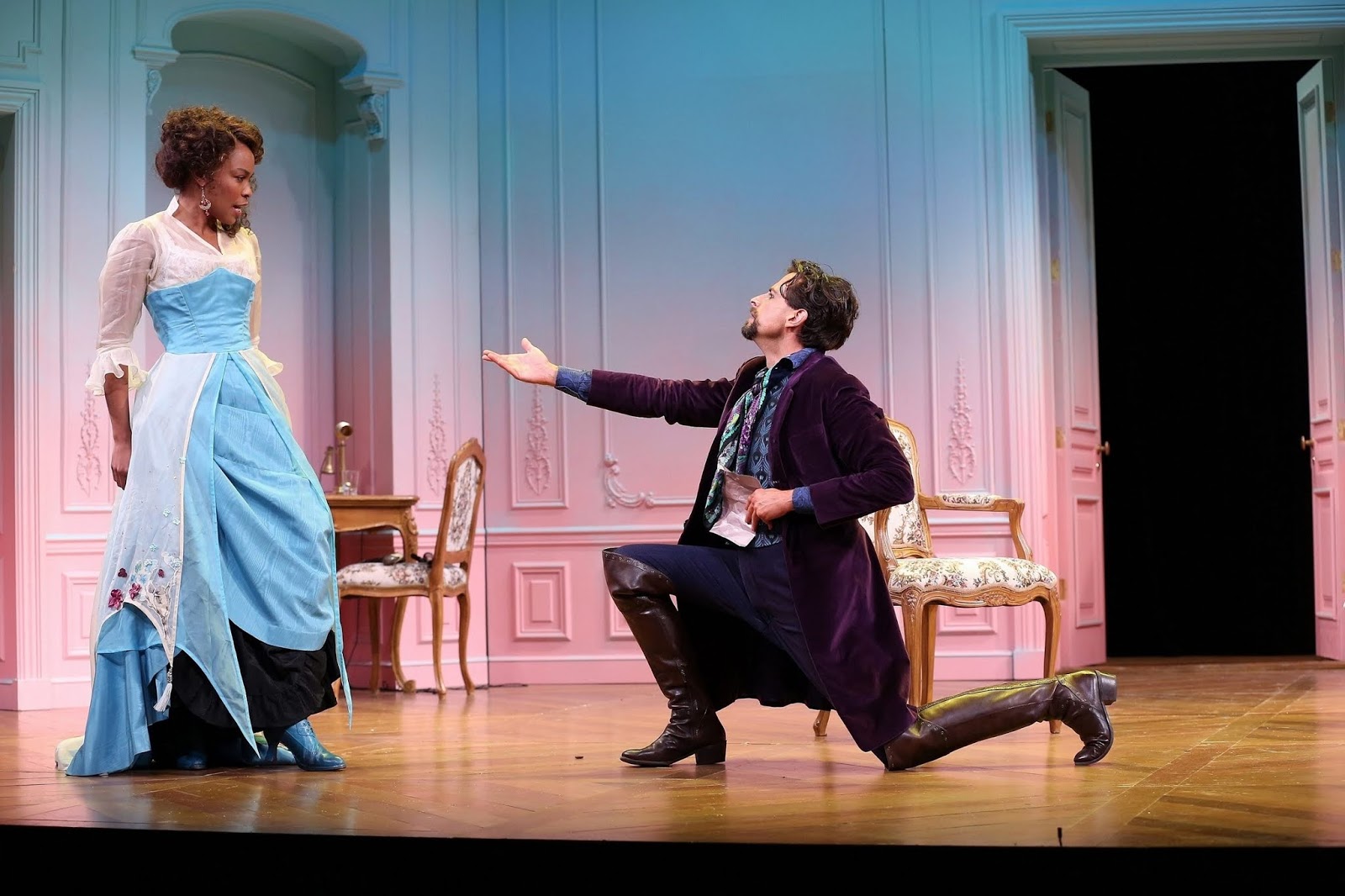
Sometimes we enjoy a book, play or movie simply because it epitomizes a genre. It may not be a great work of art but if we’re in the mood for a Rom-com, bromance or a detective story and the work follows the rules and delivers the goods, then we may not be ecstatic but we are satisfied. Such is the case with “A Flea in Her Ear,” which recently opened at Westport Country Playhouse. If you’re in the mood for farce, then this offering will satisfy. Based on Georges Feydeau’s 1907 highly successful play, adapted by David Ives and directed with brio by Mark Lamos, “Flea” has the requisite slamming doors and mistaken identities that are the bread and butter of farce, whose appeal is primarily visual and sensual, with a heavy emphasis on physical activity.
It may take you a while to settle in for this three-act play as you figure out who the characters are and their relationships. In essence, we have Raymonde (Elizabeth Heflin), wife of Victor (Lee E. Ernst), who believes, because of her husband’s recent lack of ardor, that he is being unfaithful. Her friend, Lucienne (Antoinette Robinson) suggests a ploy: they will write a letter to Victor from an admiring, anonymous lady, inviting him to a tryst at the Frisky Puss, a hotel that caters to assignations. There, Raymonde will confront him.
Receiving the letter, Victor, although initially proud that he has drawn the amorous attentions of a lady, finally decides that the letter is meant for his friend, Romain Tournel (Stephen Pelinski) and suggests that Tournel go to the hotel. Others also, for various reasons, head for the hotel: Camille (Mic Matarrese) for a rendezvous with Victor’s household cook, Antoinette (Carine Montbertrand), and Carlos (Michael Gotch), Lucienne’s husband, who suspects his wife of infidelity and is eager to take revenge. Off they all go, and so ends the first act.
Antoinette Robinson and Michael Gotch. Photo by Carol Rosegg
The second act again requires a bit of settling in. It is set at the hotel, where new characters are introduced. As those intent on trysting also arrive, chaos ensues, with a lot of slamming doors, partial disrobing and a revolving bed. Characters appear and disappear as they attempt to hide from each other. The third act finds everyone back at Victor’s house, where all is finally resolved.
The cast of “A Flea” is, across the board, excellent, but there are a few standouts First is Matarrese as Camille, for his character has a defective palate that prohibits him from pronouncing consonants. Thus, most of his dialogue must be delivered sounding like quasi-gibberish. It’s a tour de force that immediately delights the audience; when he’s on stage he effectively steals the show and engenders the greatest laughter. Then there’s Ernst as Victor, who is also charged with playing Poche, a bell boy at the hotel who bears a striking resemblance to Victor. This requires not only some rapid costume changes but also portraying a pompous Parisian gentleman as well as a somewhat inebriated servant. He pulls this off with such success that at the curtain call you half expect to see Ernst and his doppelganger taking bows.
Finally, there’s Gotch as Carlos, the excitable, gun-toting Spaniard. As directed by Lamos, Gotch gives us an acting style that went out of date almost a century ago…but works…for his every statement and move is over-the-top, as is his difficulty with the English language. He is delightfully outrageous as a preening Spanish grandee consumed by jealousy. One can only imagine Gotch’s eagerness in being given free rein to emote, and admire his skill, for one of the most difficult things to pull off on the stage is portraying a bad actor…without giving a bad performance.
Given that the play is in three acts, with two intermissions, the farce can seem a bit overwhelming at times, especially in the second act, when the audience is seldom given a moment to catch its collective breath. Event tumbles onto event in kaleidoscopic fashion, so much so that you often do not have the leisure to comprehend what has just happened before a new twist is thrown in. Here you just have to go with the chaotic flow and enjoy the extended display of the essence of farce.
Is “A Flea” brilliant theater? No, but it is what it is, and if you accept the conventions of farce then there are moments in which you can revel. Yes, the plot is highly contrived, the characters somewhat larger-than-life and the acting primarily geared to broad strokes rather than pointillist subtleties, but we go to the theater for many different reasons, and one of them is to just sit back and be entertained, and there are many entertaining moments in this broad comedy set in the Paris of the La Belle Epoque.
“A Flea in Her Ear” runs through July 28. For tickets or more information call 203-227-4177 or go to www.westportplayhouse.org.

Sunday, July 15, 2018

It's Your Call

The Arsonists -- Thrown Stone -- Thru August 4


On the Thrown Stone website, playwright Jacqueline Goldfinger suggests that her play, “The Arsonists,” was inspired by the Greek tragedy “Electra.” Well, perhaps so (who’s to say nay to the playwright, though there is the “intentional fallacy” but, whatever.) The connections seem slight (and unimportant). However, as this father-daughter exercise in memory, love and loss unfolds, one can’t but be reminded of some Flannery O’Connor short stories, for the play has a certain Southern Gothic atmosphere to it, and the characters, in true O’Connor fashion, are just a bit off-center.

In its second season, Thrown Stone, which is nested in the Ridgefield Conservatory of Dance on Main Street in Ridgefield, is offering two plays in repertory – “The Arsonists,” (a New England premiere) which opened on July 14, and “Where All Good Rabbits Go,” (an East Coast premiere), which opens July 21, with both running in tandem through August 4.

It’s difficult to put your finger on exactly what “The Arsonists,” directed by Jonathan Winn, is really about, but there’s no denying that this two-hander is blessed with two actors who easily command the stage: Nick Plakias as the father, “H,” and Emma Factor as the daughter, “M.” Together, they make the 70-minute run (with no intermission) seem to fly by.

What follows is a lot of “it would seem,” “perhaps,” and “apparently,” because from the play’s opening moments you’re never really sure if you’re watching actual events or have entered the mind of a young woman reflecting on and attempting to deal with her past. In any event, if we stay with the O’Connor motif, we have a young woman who drags home the body of her dead father in a sack while police sirens wail. The man was killed while the two, apparently, set a fire to allow someone to collect on insurance (hence the play’s title). The daughter breaks a hole in their cabin’s floor and drops in the sack, then proceeds to pick up a guitar and sing a lament. Ah, but this is Southern Gothic (the play is set in the Florida swamps), so the father rises from the dead, albeit with several parts missing. He tells his daughter he can’t truly rest until she collects the various body parts left behind in the fire, but if she does this he will leave her forever, pass on.

The Greek tragedy element is strongest with the references to the Fates, three goddesses who, in mythology, wove together a tapestry that dictated the lives and deaths of human beings. Thus, the daughter weaves while the father plays the guitar, however these strings seem, apparently (there’s that word again) to be destined as fuses for future fires, or maybe they’re just a physical metaphor.

What about the connection with “Electra”? Well, there is a deceased mother. When the daughter was eight years old she snuck into the funeral parlor, crept into her mother’s coffin and, after realizing her mother’s face was covered in bandages, fell asleep while embracing her mother’s corpse (O’Connor would have loved it). How did the mother, who was apparently (ah, once again) a bit deranged, die? Not sure. Why is her face disfigured? Again, not sure.

So, this may open up the possibility that “The Arsonists” is actually a ghost story, with the phantoms haunting the mind of the daughter and the drama, such as it is, rests in the daughter’s efforts to lay these spirits to rest. Perhaps. Much is left to the audience’s interpretation, but there’s no denying that Goldfinger’s writing is often eloquent, even poetic, and it is the primary draw of the play. Father and daughter are both given several soliloquies that are entrancing, especially M’s visit to her mother’s grave. You may not totally understand the motivation behind what is being said but there’s no denying that it is often moving. Shifting literary references, it’s much like reading (aloud) Emily Dickinson’s poetry – it sounds beautiful but, unless you’re a Dickinson scholar, are you ever quite sure what much of it means?

“The Arsonists” will not be to everyone’s taste, especially those who crave straightforward, linear development in their dramas or are uncomfortable asking themselves, “What the hell is going on here?” The staging, complete with scenic design by Fufan Zhang, is realistic, but what transpires has a bit of a dreamscape about it. All is open to interpretation.
For tickets or more information go to www.thrownstone.org.

Saturday, July 14, 2018

And God Said...

An Act of God -- TheatreWorks New Milford -- Thru August 4


What hath God wrought?

Well, he’s condescended to visit Earth to answer some questions you might have about evil, suffering, prayer and the Kardashians and, in the process, revise the Ten Commandments (most of the original set not being very applicable any more). Some might say, “Well, God help us,” but he’s tired of being asked to do things, so don’t bother. This omnipotent, omniscient being has chosen to manifest himself at TheatreWorks New Milford in a new comedy, “An Act of God,” an often irreverent one-act show that’s part stand-up comedy, a bit of ad-lib and part SNL take-down of the pompous and the PC police who are ever ready to huff and puff over humanity’s less than sanctimonious ways.

God has chosen to take the form (i.e., inhabit the body of) Matt Austin. He is accompanied by two of his chief angels, Gabriel (Suzanne Powers) and Michael (Josh Newey). While God begins to explain what’s what with the creation story and the truth of the Bible, Gabriel provides props and appears with new commandments while Michael works the crowd, sensing what questions they might have for God – many of them real posers.

Josh Newey, Matt Austin and Suzanne Powers
Directed by Katherine Ray and written by David Javerbaum, this take on God letting his hair down and fessing-up to some mistakes he’s made along the way – yes, he’s omniscient, but that doesn’t mean that he wants to know everything, just that he could – may make some people squirm a bit, but if nothing else it, beyond the humor, makes you think.

Think about what? Well, how about the Creation story – the six days of creating the earth and the fish and birds and all that stuff and, finally, man? Well, make that men, for after God created Adam and saw that he was lonely he created a helpmate in the form of Brian. They got along famously until the snake conned Brian into eating that apple and the two men realized they were performing “unnatural” acts. Ooops! Can’t have that, so God created woman. Makes sense, as does the story of Job, which God thinks is the most hilarious book in the Bible. What doesn’t make sense is the whole Noah and the ark story. As God points out, how the hell would all those animals fit into that ship – and what about the hygiene? Actually, besides his family, Noah only brought along two puppies to keep everyone company on the long voyage.

Austin is dead-on as a god who wants to set things straight. His take on God is as a talk-show host – think Johnny Carson – shooting out zingers and one-liners and then feigning innocence. As his assistants, Newey gives us an all-to-human Michael who often has the audacity to question God’s wisdom, while Powers is as flighty as a butterfly, eager to do God’s bidding.

The evening is lighthearted, but underneath the comedic surface Javerbaum addresses some issues that bear consideration as he has God revise the Ten Commandments. At one point, God tells people that they have to stop killing in his name, although he confesses that he’s done more than his fair share of slaughter. After all, he flooded the planet.

In the end, God really can’t answer many of the existential questions that human beings have pondered since time immemorial. His final decision is to leave us to our own devices, to continue pondering the imponderables. In other words, he’s as fallible and troubled as we are, admitting that he has a “wrath” issue and perhaps went too far with Abraham and Isaac and that his divine plan – he initially thought that the fish should fly and the birds swim – always didn’t work out as expected. Hence, we are left with the idea that God is our own creation, and that he didn’t make man in his likeness but we made him in ours.

Theater is meant to entertain, but it is also meant to stimulate thought and conversation. “An Act of God” does both. I can envision many lively discussions post-curtain for those who attend and go out for a cocktail (or tea) afterwards. If nothing else, via humor, sarcasm and innuendo, the play challenges received beliefs, something that needs to happen every once in a while to defeat the smugness of those who claim to know the truth and damn all those who do not believe as they do. Kudos to TheatreWorks for deciding to stage this play. It may ruffle some feathers and tilt some halos, but maybe those feathers need to be ruffled just a bit and the halos need to be put in a drawer.

“An Act of God” runs through August 4. For tickets or more information go to www.theatreworks.us or call 860-350-6863.