Wednesday, November 12, 2014

A Wise and Witty "Walk in the Woods"

"A Walk in the Woods" -- Square One Theatre Company -- Thru Nov. 22

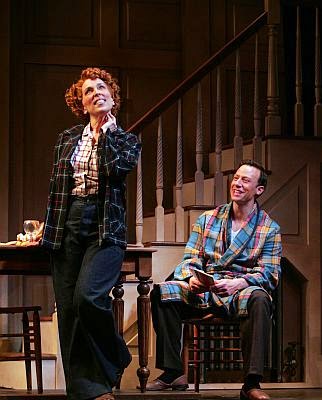
                                             Pat Leo and Damian Long

By Geary Danihy

In a theater on Main Street in Stratford, two men sit on a bench…and talk.

That might be the synopsis of Lee Blessings play, “A Walk in the Woods,” as written by a bored high school freshman born well after the demise of the Cold War. And he would be right -- it is a play about two men who sit on a bench in the woods and talk – but this freshman, a bit obtuse and eager to get back to playing “Call of Duty,” would perhaps miss the point of the conversations these two men are having, for inherent in what they touch upon, both directly and obliquely, is both the essence of recent history and, more important, the essence of man’s eternal search for a way to end conflict, an uneasy exercise, fraught with distrust, in finding a formula that might just lead to a tentative setting aside of shields and swords,

As capably directed by Square One Theatre Company’s artistic director Tom Holehan, “A Walk in the Woods,” which was nominated for a Tony award and a Pulitzer Prize when it first appeared in 1988, is invested not only with a sense of the recent historical past but also, in this production, with just a bit of nostalgia, for Pat Leo, who plays the Russian diplomat Andrey Botvinnik, has appeared in this play once before at Square One. He did so 25 years ago, for “A Walk in the Woods” was the first play Square One boarded, and Leo played the role of John Honeyman, the young American negotiator, played in this production by Damian Long, who is making his Square One debut.

The play is set in the woods outside of Geneva, the city where Soviet and American diplomats are trying to hammer out an arms limitation treaty that might just nudge the world several inches back from the abyss of Armageddon. The talks are not going well, for there is distrust and hidden agendas on both sides, but in the woods two of the negotiators meet on a regular basis to see if some common ground can be found. Botvinnik, the Russian, has a wry sense of humor, is sophisticated and a master at the give and take of diplomacy, but as ably portrayed by Leo, he is also jaded, cynical and holds out little hope for the success of the negotiations.

Botvinnik’s counterpart, Honeyman, is new to the negotiation game, and although the American is eager to bring the negotiations to a successful conclusion, he is naïve and just a bit stiff and pompous.

There are actually two sets of negotiations going on in this play: the stated one dealing with arms reduction, which the audience hears about but never sees, and the more inter-personal negotiations between two human beings learning how to talk to each other and, if possible, become friends. Thus, Leo and Long are charged with creating an atmosphere that, on the personal level, mirrors the hesitancy and distrust that exists at the negotiating table in Geneva. This they do quite admirably, for over the course of the two-act play each character slowly sheds his status as negotiator and simply becomes a person seeking to understand another person, which is obviously at the heart of playwright Blessing’s message, for if we cannot understand and reach accord as fellow members of the human race, then we will forever be ruled by nationalism and the false pride engendered by our proclaimed “differences.”

It may sound as if the play’s content is weighted down by socio-political theory, but that is not the case. Although the play deals with weighty subjects and touches on the disparate, perhaps intransigent, nature of the two political systems these men represent, the growing relationship between the men, separated as they are by culture and decades, is the play’s focus, and is presented with a great deal of humor, as established in the opening scene when Honeyman is eager to get down to brass tacks and, in response, Botvinnik suggests that they talk about…nothing…trivia…anything but the topics that are on the table back in Geneva. Over the course of the play, the two men, believably brought to full life by Leo and Long, find a tentative common ground where the cynicism of age and the idealism of youth can coexist, and, in the process, may just also find a way to “prevent the total destruction of every living thing on this planet.”


“A Walk in the Woods” runs through Nov. 22. For tickets or more information call 203-375-8778 or go to www.squareonetheatre.com

Monday, November 10, 2014

A Delightful Merry-Go-Round of Song and Dance

The World Goes 'Round" -- MTC Mainstage -- Thru Nov. 23

                       Melissa Carlile-Price, Aaron Young, Trisha Rapier, Kathy Calahan
                       and Eric Scott Kincaid. All photos by by Joe Landry 


MTC Mainstage is celebrating the opening of its new theater in Norwalk with a production of “The World Goes ‘Round – The Songs of Kander & Ebb,” a tuneful, collection of songs from the creators of such hits as “Chicago” and “Cabaret.” As directed by Kevin Connors, MTC’s executive artistic director, “The World Goes ‘Round” is an excellent choice to showcase MTC’s new digs, for it captures the spirit of the “old” MTC while highlighting the new possibilities that the larger quarters offer MTC, now in its 26th year

“The World…” is basically a revue with a faint attempt at a frame that all but disappears after the first 10 minutes of the show, but that really doesn’t matter. What does matter with a show like this is the cast, because the actors, basically without a book to work with, have to create the mood and context for the songs essentially in a vacuum. Yes, many of the songs will be familiar to theatergoers who have seen Kander and Ebb’s musicals, but in the musicals the songs are delivered by characters the actors have had a chance to develop – when Sally Bowles sings “Maybe This Time,” in “Cabaret,” the audience understands where the song is coming from. When Trisha Rapier sings the song in “The World…,” she does so without the benefit of all that has come before the number in the musical. In other words, it’s all on her. Fortunately, Rapier is more than up to the task – the number is a heartbreaking plea for love, for something more than a one-night stand.

                                                            Trisha Rapier

In fact, the entire cast is more than up to the task. Rapier, Kathy Callahan, Melissa Carlile-Price, Eric Scott Kincaid and Aaron Young sell song after song, shifting gears as necessary with verve, energy and aplomb.

                                     Melissa Carlile Price and Aaron Young

The intimacy that MTC has been known for is still there, but the larger space has allowed for the show to be lit in a truly professional and effective manner by Michael Megliola, and now MTC can present full choreography, this time crafted by Jeri Kansas. However, as with all moves into new and larger quarters, it takes time to get used to the new space, to own it and know how to use it most effectively. Thus, there are certain line-of-sight problems and a question of just how far down-stage the actors should be blocked, but these will be corrected as the creative team becomes more comfortable with the new space. The only really disappointing part of the evening was the set designed by David Heuvelman. It was certainly functional, but there was little glitz or pizzazz. So much more could have been done to enhance the overall look and excitement of the show.

So where does the excitement come from? The actors. In number after number, they sell the songs, creating many high points. There’s the caffeine-frenzy of “Coffee in a Cardboard Cup” (you can see the caffeine take effect) and the wistful “Colored Lights.” Each of the extremely talented cast members has his or her moment to shine. There’s the aching pathos of the “Mr. Cellophane” number, ably captured by Kincaid. As mentioned above, Rapier, the belter of the quintet, nails “Maybe This Time,” and leggy Carlile-Price dazzles as the lead in “Ring Them Bells” – and the duo does wonderful takes on “The Grass is Always Greener” and “Class.” And who can resist the delight Calahan evokes as she spends some time with “Arthur in the Afternoon’? Finally, there’s the soulful “Marry Me,” an achingly beautiful cri de coeur that Young makes you believe is truly coming from his heart.
                           Eric Scott Kincaid (foreground), Kathy Calahan, Aaron Young,
                          Melissa Carlile-Price and Trisha Rapier


The best is saved for last, for the show ends with three numbers performed by the entire cast: “The Money Song,” “Cabaret” and the theme from “New York, New York.” The energy is palpable, the talent more than obvious.

Anyone who loves musical theater and appreciates well-honed, exuberant performances will delight in “As the World Goes ‘Round.” You will come away humming a tune and perhaps dancing several steps before you reach your car. The evening is infectious, in the best sense of the word.

“The World Goes ‘Round” runs through Nov. 23. For tickets or more information call 203-454-3883 or go to www.musictheatreofct.com

Saturday, November 8, 2014

Law of the Jungle Surfaces in Suburbia

God of Carnage -- Darien Arts Center Stage -- Thru Nov. 22

                   Larry Reina and cast of 'God of Carnage' -- Photo by Jeffrey Wyant

By Geary Danihy

Who trusted God was love indeed
 And love Creation's final law
 Tho' Nature, red in tooth and claw
 With ravine, shriek'd against his creed

If Tennyson had had the opportunity to see Yasmina Reza’s award-winning “God of Carnage,” which recently opened at the Darien Arts Center Stage under the capable direction of Mark Graham, he might have considered revising his poem, for as Reza would have it, underneath all that love and civilization lurks the beast, the worshipper of the god of carnage, who needs little provocation to bare his, or her, fangs and claws.

Billed as “A Comedy of Manners…without the Manners,” “God of Carnage,” translated by Christopher Hampton, presents two oh so civilized couples whose children, two sons, have had a schoolyard fight. Benjamin, son of Annette and Alan Raleigh (Jessie Gilbert and Lawrence Reina), apparently took a stick to Henry, son of Michael and Veronica Novak (Gary Betsworth and Eileen Lawless), giving the lad a puffed lip and damaging two teeth. The Novaks have invited the Raleighs over to discuss the matter as mature adults, because mature adults can work things out in a calm, logical, sophisticated manner…Not!

What begins as a politically correct discussion of the schoolyard altercation soon devolves into a visceral autopsy of the two couples’ lives, with recriminations and insults flying as fast and deadly as arrows at Agincourt. Reza takes delight in scraping away at the two couples’ veneer of suburban sang froid, but she goes deeper as the play questions humanity’s true nature, suggesting that we really haven’t distanced ourselves from the club-wielding Neanderthals.

Much of the play’s humor is to be found in the peeling away of the four adults’ surface personas to reveal the feral, frightened children that huddle beneath, with the operative irony being that the catalyst for the adult confrontation is…kids getting into a fight.

The danger in choosing to board Reza’s play is that her four characters border on caricature. Thus it falls to the actors, and the director, to ensure that what the audience sees on the stage are flesh and blood humans rather than cardboard cutouts. This task the four actors in the DAC production accomplish, by and large, with skill. As in most relationships there will be an alpha and a beta – in the case of these two couples, the alphas are Alan, a lawyer for a pharmaceutical company, and Veronica, an author and champion of human rights. Reina nails the amoral lawyer, giving us a man surgically attached to his cell phone who, throughout the evening, continues to take calls dealing with a pending scandal about one of the company’s drugs. His advice embraces lying and across-the-board denial.

Given the nature of alphas, Alan and Veronica immediately antagonize each other, and Lawless plays well off Reina’s work-obsessed character, creating a woman who is just this side of self-righteous, who wraps her opinions and sense of self in the flag of suffering humanity.

The two betas are Michael and Annette. Betsworth sometimes takes his character’s submissive nature just a bit too far, but his eruption over the death of a hamster (don’t ask) is priceless. It is, however, Gilbert who gives us the most nuanced performance of the evening, transforming her character from a somewhat put upon adjunct to her husband’s life into a tigress defending her young while literally dousing her husband’s cell-phone ardor.

The single set by David Eger is functional but somewhat linear, which Graham initially seems to succumb to in the opening scenes as he aligns his characters stage right to left and then leaves them there, standing behind a table, delivering their lines. Perhaps the blocking here is meant to convey the couples’ initial awkwardness, but it’s just a bit too static. However, Graham soon has his actors using the full (limited) stage area, wisely rearranging the two couples as alliances form and dissolve and allegiances are challenged – it’s a visual enhancement of the ebb and flow of the couples’ changing relationships and the power shifts that occur during the one-act play.

Inevitably, the meeting over a schoolyard fight leads to violence, which provides a catharsis of sorts, and concludes with the four adults emotionally drained, left to contemplate the damage they have wrought, the truths that have been revealed, and to face the uncomfortable question uttered by Michael in the play’s final line: “What do we know?”

This tidy, often trenchant production has many humorous moments, but the laughter is tinged with a certain amount of discomfort for it doesn’t take long to realize that what we are laughing at are our own foibles, shibboleths, hypocrisies and neatly constructed “civilized” personas.

"Now this is the law of the jungle, as old and as true as the sky,
 And the wolf that shall keep it may prosper, but the wolf that shall break it must die.” – Rudyard Kipling


“God of Carnage” runs weekends through Nov. 22. For tickets or more information call 203-655-5414 or go to www.darienarts.org.

Saturday, November 1, 2014

"Gracie" -- Nostalgic and Touching

"Say Goodnight, Gracie" -- Ivoryton Playhouse -- Thru Nov. 18

                      R. Bruce Connelly as George Burns-- Photo by Rose Picarelli

As you sit watching “Say Goodnight, Gracie,” which recently opened at the Ivoryton Playhouse, a question slowly arises: must you be of a certain age to truly enjoy this one-character, one-act play? The answer is yes…and no, for “Gracie” is as much a love story as it is a trip down Memory Lane. It is also a quintessential American story that embodies the spirit of the Horatio Alger novels: a young lad of low beginnings, through luck and pluck, makes his way in the world and becomes a success.

Who is Gracie? Well, that’s part of the generational conundrum that is at the heart of embracing the play and appreciating R. Bruce Connelly’s performance, for Gracie is Gracie Allen, the ditzier part of the Burns and Allen comedy team that made it big in vaudeville, then on radio, in movies and finally on television, a career that spanned multiple decades.

And who is the man up there on the stage reminiscing? Well, it’s the other half of the team, George Burns. So, who’s George Burns? There’s the rub, because if you know who George and Gracie are then you’re into the play from the moment Connelly walks out onto the stage, cigar in hand, and has a conversation with God (whom he played in three movies – turns out God and George are big fans of each other). If you’re clueless, well, it will take some time for the play, written by Rupert Holmes and directed by Michael McDermott, to bring you up to speed…and you may never get to full open throttle. Hence, depending on when you arrived on this planet, you may well have a different experience watching “Gracie.”

Since I arrived six-plus decades ago, I had no problem relating to and appreciating Connelly’s take on the iconic comedian. Connelly has the mannerisms – the pensive, somewhat perplexed pauses, the open-mouthed smile – down pat, as well as the somewhat gravelly drawl with which he delivers his lines. He also does a great Jack Benny – ah, who’s Jack Benny and what’s the deal with the violin? Again, another Checkpoint Charlie that either lets you into the play or keeps you out – Ah, what’s Checkpoint Charlie? Stop it. You’re making me feel my age.

The frame for the play is that Burns has just passed and now finds himself before the Pearly Gates. However, before he can enter Paradise and be united with his beloved Gracie, he is asked by God to audition. Audition? Yes. How? By telling the story of his life…and we time-travel back to the tenements of turn-of-the-century New York.

What follows is oral autobiography, as Connelly weaves a tale of a young Jewish boy who sells papers and ice to help his family make tattered ends meet, a boy who begins singing with three other Jewish lads and soon comes to realize that there might be money to be made by entertaining people.

Then it’s on to vaudeville, with the young Jewish boy taking on many roles (and names, most of them Irish) and finding limited success until he happens on a wisp of an Irish lass named Gracie. He suggests that they form a team. She hesitantly agrees. They rehearse and then try out their act, with Gracie delivering the straight lines and George following with the zingers. Only problem is, Gracie’s straight lines get more laughs than George’s comedic rejoinders. George, a savvy veteran of the vaudeville circuit, realizes that a change needs to be made in the act if the team is going to survive: the audience loves Gracie, and she’s getting the laughs, so…he becomes the straight man and Gracie, well, Gracie blossoms in all of her character’s ditziness. It’s a formula that will take them to stardom and last for decades.

Oddly enough, the play’s pacing mirrors the graph of Burns’ career, for things start to drag a bit as Connelly relates, perhaps with greater detail than necessary, the ups (few) and downs (many) of Burns’ vaudevillian efforts, but Gracie saves the day, for although there is no actress playing her, there are stills of her projected onto a screen (later, clips from the films they made and then from their television show), and then there’s her voice, high-pitched, somewhat scratchy, with every line she delivers seeming to end with a question mark, as if she herself is unsure of what she is saying. From the moment Gracie “appears,” the show takes on a new life, and it’s to Connelly’s and Holmes’ credit that Gracie is given her due. There’s an especially lovely moment, soon after Burns realigns the act and makes himself the foil to Gracie’s zaniness, when Connelly sits in a chair as we hear Gracie prattle on, her illogical statements making a weird sort of sense. With each line that Gracie delivers, Connelly turns towards the audience and smiles – he doesn’t have to say it, but we know he’s thinking, “That’s my Gracie.”

I wish I had had one of my grandsons with me during opening night, not only for his company but to ask him on the drive home what his take was on the show. He would not have recognized the theme from George and Gracie’s television show, he probably wouldn’t know who Eddie Cantor, Jimmy Durante or Fanny Brice were, but that’s okay. What I would have wanted to know is if he had gotten what the play was about. Did he see that, beyond show business, beyond fame and fortune, what’s important is the magical intermingling of two lives, an intermingling that was played out for all of America to see. Was he moved when George visits Gracie’s grave every week just to talk with her and keep her updated on what is happening in his life? Did the final moment of the play perhaps bring a tear to his eye, when Gracie tells George that he, himself, should say goodnight? I can only hope that he would have answered in the affirmative.


“Say Goodnight, Gracie” runs through Nov. 16. For tickets or more information call 860-767-7318 or go to www.ivorytonplayhouse.org.

Monday, October 27, 2014

Do You Have a Musical In You?

DATES AND SUBMISSION GUIDELINES ANNOUNCED FOR YALE INSTITUTE FOR MUSIC THEATRE


ONLINE SUBMISSIONS ACCEPTED OCTOBER 23 THROUGH JANUARY 7

Online submissions are being accepted beginning today through January 7 for the 2015 YALE INSTITUTE FOR MUSIC THEATRE.

Established in 2009, the YALE INSTITUTE FOR MUSIC THEATRE is a program of Yale’s Binger Center for New Theatre that bridges the gap between training and the professional world for emerging composers, book writers, and lyricists. The Institute seeks distinctive and original music theatre works to be developed in an intensive two-week summer lab at Yale School of Drama. The Institute matches the authors of the selected works with collaborators, including professional directors and music directors, as well as a company of actors and singers that includes professionals and current Yale students. The lab culminates with open rehearsal readings of each project, presented as part of New Haven’s International Festival of Arts & Ideas.

The Binger Center for New Theatre has distinguished itself as one of the nation’s most robust and innovative new play programs. Since 2008, the Binger Center has supported the work of more than 40 commissioned artists and underwritten the world premieres and subsequent productions of 18 new American plays and musicals at Yale Rep and theatres across the country. The Binger Center also facilitates residencies of playwrights and composers at Yale School of Drama, including those who are selected to participate in the Yale Institute for Music Theatre.

Under the leadership of Artistic Director Mark Brokaw, two original music theatre works will be selected for the 2015 Institute, which will take place June 13–28 in New Haven. Online applications are being accepted now through January 7, 2015, 11:59PM (EST) at drama.yale.edu/YIMT.

ELIGIBILITY

The Yale Institute for Music Theatre accepts applications for projects at various stages of development but focuses on work that is ready to be explored musically and dramatically with performers and directors. Submissions cannot have had a professional production.


Book musicals and other imaginative music theatre projects are welcome. Only composers, book writers, or lyricists who are current graduate students; or who have graduated from an accredited degree-granting institution (undergraduate or graduate) within the past five years; or who are current Yale students (undergraduate or graduate) are eligible to apply.

Applicants may only submit one work for consideration. Composers and writers may apply as individuals or as part of a team.

Participants must be available for the full duration of the residency. Each member of the writing team will receive an honorarium of $1,000, as well as round-trip transportation and accommodation.

GUIDELINES FOR SUBMISSION

Online submissions will be accepted beginning October 27, 2014, through 11:59 PM (EST) on January 7, 2015.

All submissions must include each of the following, and all documents (with the exception of music recordings) must be uploaded as PDFs:

1-     APPLICANT BIO: a BIOGRAPHY or resume of no more than one page, for each creative artist;

2-     SYNOPSIS/SONG LIST/SCRIPT/SHEET MUSIC

a.     a SYNOPSIS of no more than one page, with a list of characters and instrumentation;

b.     a SONG LIST

c.     a SCRIPT with lyrics or a full libretto;

d.     SHEET MUSIC for a minimum of five songs; 

3-     MUSIC RECORDINGS: a sample of at least 20 minutes of music. The sample must include the five songs for which sheet music is submitted. Piano and vocals are sufficient, and a composer’s demo is acceptable though not preferred. Studio demos are not necessary. Music recording files must be clearly labeled and uploaded in sequence. All submitted recordings must be clearly noted in script.

4-     DEVELOPMENT HISTORY AND GOALS: a brief description of the work’s history and what the creative team hopes to achieve from the development process at the Institute; 

5-     RIGHTS STATEMENT: proof of fully secured rights if the proposed project is an adaptation of an existing work that is not in the public domain;

6-     SIGNATURE: an electronic signature from the Lead Applicant on behalf of all Co-Applicants (composer, book writer, lyricist).

Note: All 2015 applications must be submitted electronically. The Institute does not accept video recordings or photographs.

For more information about the Yale Institute for Music Theatre or the application process, please email yimt@yale.edu or call (203) 432-5348.


All applicants will be notified of selection by March 27.

Sunday, October 26, 2014

The Catcher in the Court

"Hamlet" -- Hartford Stage -- Thru Nov. 16

                                              Brittany Vicars and Zach Appelman
                                             All photos by T. Charles Erickson


By Geary Danihy

Over the centuries, critics and playgoers alike have had, if not problems, at least questions about “Hamlet,” most centering on the eponymous character himself. Chief among these “questions” is the prince’s apparent madness – is it pretense, real, or a little bit of both? The current production of Shakespeare’s tragedy at the Hartford Stage, under the sure-handed, creative guidance of artistic director Darko Tresnjak, appears to answer this and many other questions. This illuminating and totally enjoyable night of theater gives us a Hamlet for the twenty-first century while staying true to the Bard’s original intentions. It is a must-see production for theater-goers of all ages, but especially for students who think Shakespeare is “boring!”

The answer to the question posed above is in the form of Zach Appelman’s take on the prince. Many fine actors have played this role, some well into their careers, so we often forget that Hamlet is a stripling, a student, a bright, somewhat opinionated, sharp-tongued college student – you know, someone who perhaps over-indulges in a beer hall, is full of his new-found knowledge and revels in his rebellion against those who have made the mistake of becoming adults and therefore, by definition, are either hypocrites or phonies. Yes, there’s just a touch of Holden Caufield in Appelman’s prince of Denmark…and it works, so much so that laughter often punctuates the evening, something seldom heard when attending a production of “Hamlet.” Appelman, under Tresnjak’s focused direction, has given new life to a character often made ponderous by an over-emphasis on brooding, self-doubt (even self-hatred) and oedipal urges.

                                        Kate Forbes and Andrew Long

Yes, Appelman’s Hamlet is conflicted, but that doesn’t stand in the way of his taking a certain perverse delight in playing the role of the aggrieved son of a murdered father, for Hamlet, as is readily apparent in the scene with the troupe that has arrived at Elsinore to entertain, has thespian tendencies, and these tendencies are part of what leads to Ophelia’s suicide and the violent end of the story. It has often been suggested that Hamlet’s “tragic flaw” is his propensity for hesitation, but in this production it becomes apparent the “flaw” is that Hamlet is, at heart, just a boy, a very smart, perceptive boy, but a boy just the same, and the ghost of his murdered father, who demands that his son avenge his murder, thrusts Hamlet into a world of adults that he comprehends all to well intellectually but is ill-equipped to deal with emotionally. Hence, Hamlet does what many a young adult would do in this situation, he takes on roles, multiple roles to fit the moment, and derives a certain delight in the play-acting.

Appleman is supported by a strong cast, with James Seol as Horatio, Andrew Long as King Claudius, Kate Forbes as Queen Gertrude and Brittany Vicars as Ophelia. It is, however, Edward James Hyland, as the pontificating Polonius, who most ably helps to define Hamlet’s character, for if Appelman’s Hamlet is the essence of brash youth then Hyland’s Polonius is the antithesis, an adult, perhaps once a brilliant student, who has become enamored of his own wisdom and words, a man Hamlet makes fun of yet, seeing this production one gets the sense that if Hamlet had lived and aged into his semi-dotage he might easily have become a Polonius – they are the yin and yang of the same character: full of themselves and eager to dispense their versions of “wisdom.”

                                                Edward James Hyland and Brittany Vicars

Tresnjak, who has done double duty here as scenic designer, has been guided by the idea that “the play’s the thing,” so the minimalistic set (save for the dead king appearing astride a horse – an arresting moment), consists of a raised platform, top-lit and illuminated from below by lighting designer Matthew Richards, that resembles a Celtic cross, a cruciform framed by three black benches. Except for a chandelier that descends to signify court scenes and faux proscenium arches that frame the traveling actors’ play within a play that captures “the conscience of the king,” the stage is left to the actors to create the world of Elsinore, which they do brilliantly, garbed in glorious period costumes by Fabio Toblini.

There are those who deem themselves “purists” – whatever that means – who may find Appleman’s Hamlet a bit too excessive, a bit too flippant, and might quote Hamlet’s own words to the traveling actors as a criticism of Appleman’s somewhat hyperactive prince: “Nor do not saw the air too much with your hand thus, but use all gently, for in the very torrent, tempest, and (as I may say) whirlwind of passion, you must acquire and beget a temperance that may give it smoothness.” But Appleman’s gestures, his artifice, his antsy feet and limbs, are all of a piece with the idea that his Hamlet is playing a role, although the role-playing soon takes on a life of its own and carries the young prince far beyond his nascent understanding of the situation. Wrapped up as he is in the thrill of the artifice he has little awareness of the impact his actions have on others.

                                   Adam Montgomery, Floyd King (center)
                                  and the cast of Hamlet

All in all, this is a vibrant, artistic rendering of Shakespeare’s most psychologically perceptive, challenging play. Tresnjak and company give us a “Hamlet” that some may find disturbingly off-center, but for others, this is a “Hamlet” that reveals aspects of the play that have heretofore not been given full consideration. In the end, we are presented with the idea that “Hamlet” is about “theater” as it manifests itself in our daily lives. Thus, there is a play within a play within a play, with Hamlet the playwright, the protagonist and, tragically, the victim of his own creation. Ophelia’s corpse and the bodies strewn on the court floor at the end of the play are testaments to the lethality of artifice, play-acting taken too far -- something callow youths are prone to do as they become enraptured by their enthusiasms or captured by their bedevilments.


“Hamlet” runs through Nov. 16. For tickets or more information call 860-527-5151 or go to www.hartfordtsage.org. 

Wednesday, October 22, 2014

A Fitting Farewell

"Irving Berlin's Holiday Inn" -- extended thru Dec, 21 -- Goodspeed Opera House

                           The cast of Irving Berlin’s HOLIDAY INN are
                           “Shaking the Blues Away” All photos by 
Diane Sobolewski

By Geary Danihy

What a lovely dessert to serve for Michael Price’s going-away party. After 48 years, Price, executive director of Goodspeed Musicals, is moving on, leaving behind a legacy unmatched in Connecticut – and national – theater. He is, without a doubt, the defining force behind all that Goodspeed has come to stand for, so it is fitting that the final production of his career at Goodspeed, “Irving Berlin’s Holiday Inn,” display the style, quality and talent that has drawn crowds to the venerable theater for decades.

As directed by Gordon Greenberg, who co-authored the book with Chad Hodge, and choreographed Denis Jones, “Holiday Inn” is a delightful evocation of the golden age of both Broadway and Hollywood musicals. There’s singing, dancing and romancing and a light-hearted plot. As my play-going partner commented upon leaving Goodspeed that evening, you always come away feeling good, and that’s because Goodspeed under Price’s direction has never lost sight of its primary function, which is to present classic musical theater without any shrugs or winks. Basically, Goodpseed gives its audience what it wants, and that’s what keeps the folks coming back.

                                            Patti Murin and Noah Racey

“Irving Berlin’s Holiday Inn” is a classic example of what Goodspeed is, well, so good at. There’s a raft of talented actors, a set, created by Anna Louizos, that explains why so many theater companies around the country with limited space seek our Goodspeed for advice, costumes (there has to be at least six or seven major costume changes for the cast over the course of the evening) by Alejo Vietti that dazzle, and dance numbers choreographed by the aforementioned Jones that seem both spontaneous and studied (in this case, a close study of some of Fred Astaire’s memorable numbers).

The plot doesn’t require much of a synopsis. Jim Hardy (Tally Sessions), Ted Hanover (Noah Racey) and Lila Dixon (Hayley Podschun) have a song and dance act. Jim and Lila are engaged, but Ted lures her away with dreams of Hollywood glory. Seeking solace in the simpler life, Jim, sight-unseen, buys a farm in Connecticut, the ancestral home of Linda Mason (Patti Murin).

                                              Hayley Podschun as Lila Dixon
                                              and Noah Racey as Ted Hanover

Jim soon realizes that the farm will not pay for itself, unless…why not turn it into an inn, an inn that puts on musical extravaganzas on all of the major holidays (What’s to be done for income the rest of the year? Don’t ask. It’s a musical!) With the help of Louise (Susan Mosher), the local handywoman and the musical’s comic relief, the inn is transformed, Linda, who once had acting aspirations, is induced to become involved, Jim and Linda start to have feelings for each other, Ted reappears, having been jilted by Lila, and goes into his ‘Hollywood dreams’ routine with Linda, she bites, Jim once again is despondent…oh, will true love eventually win out? Yes, you’ve seen variations on these time-worn themes many times before, but they work, and they work admirably at Goodspeed. If you’re yearning for “The Cherry Orchard” or “A Doll’s House,” go elsewhere. The plot is the all-purpose flour and yeast that help make the cake; the songs (a pastiche of classic Irving Berlin songs) and the dance routines are the luscious fillings that make this particular dessert so delightful.

                                          Susan Mosher as Louise and
                                          Tally Sessions as Jim Hardy 

The songs? Yes, of course, there’s “White Christmas,” that paean to a time and a holiday that exists primarily in American myth (and perhaps, for a certain age group, brings on suicidal thoughts around holiday-time), but there’s also “Out With My Baby,” “Blue Skies,” “What’ll I Do?,” “You’re Easy to Dance With” and “Be Careful, it’s My Heart.” And then there’s “Shaking the Blues Away,” perhaps not one of Berlin’s most memorable songs but it becomes a show-stopper with Jones’s choreography that, most notably, involves three dancers jump-roping with a long length of garland. This number epitomizes what Goodpseed is all about – it’s innovative and exuberant.

The show’s penultimate number, “Let’s Take an Old-Fashioned Walk,” perhaps says more than it is meant to, for that is what Price has focused on over his 46 years at Goodspeed, an old-fashioned walk down the memory lane that is American musical theater, and he’s brought us along, and for that, if for nothing else, we can be ever grateful. Thank you, Michael, for all of those walks.


“Irving Berlin’s Holiday Inn” has been extended through Dec. 21. For tickets or more information call 860.873.8668 or visit: www.goodspeed.org.